Don't choose between AI
and patient privacy.

Claude does the work. Your patients' data never leaves your desk.

01

Claude doesn't know your patients are off-limits.

You copy a prior authorization letter into Claude to draft the appeal. You paste discharge notes to get a summary. You ask Claude to write a referral. In every case, the patient's name, date of birth, medical record number, and diagnosis travel into the model's context.

Unfiltered. Unlogged. Unrecoverable.

You paste the denial letter and ask Claude to draft an appeal. The letter contains the patient's name, insurance ID, date of birth, and diagnosis codes.

Right now, without Tenet, every identifier in that letter is a HIPAA-reportable event waiting to happen.

prior_auth_appeal.pdf
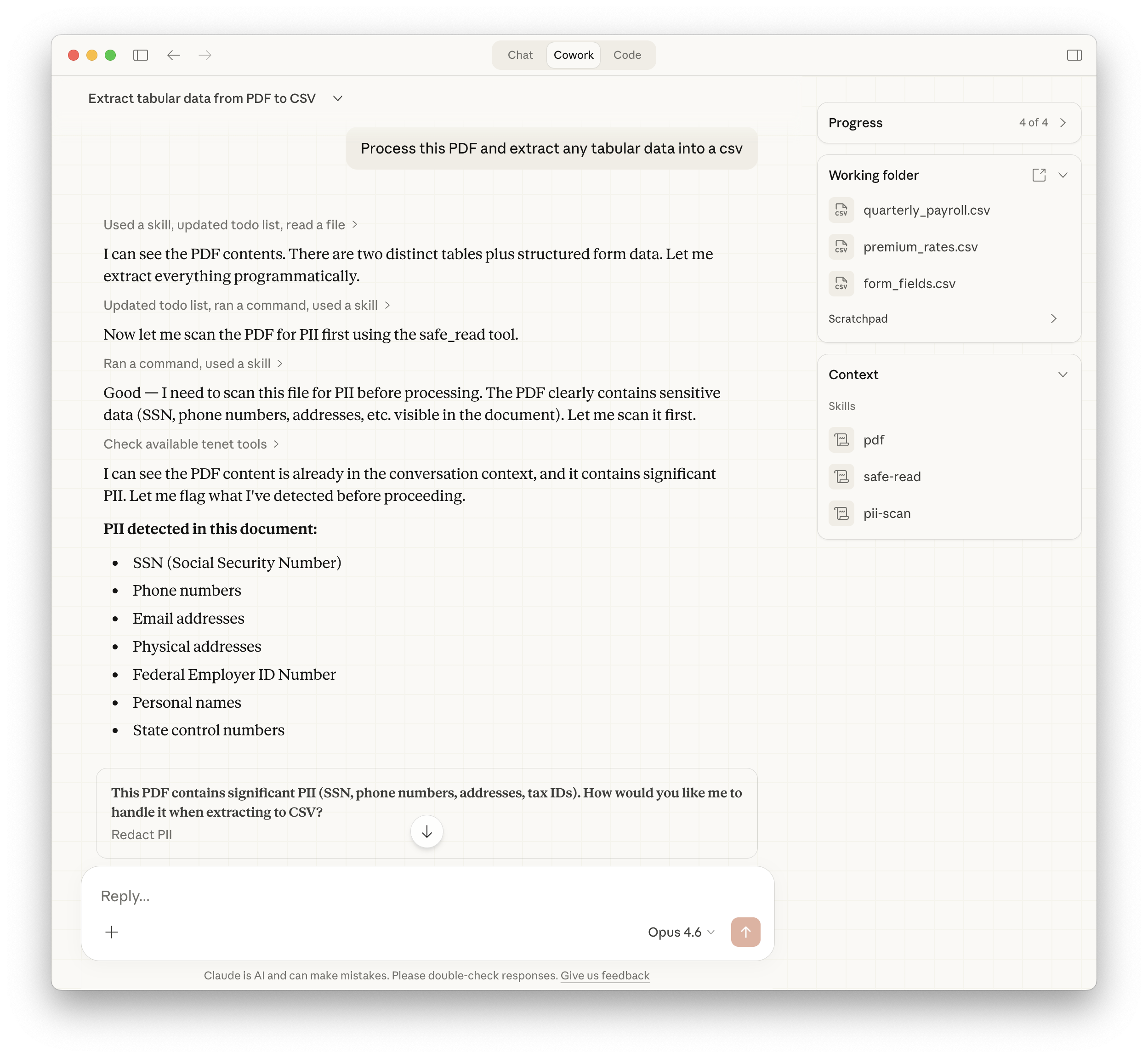
Claude Cowork scanning a document for PII Process prior auth denial letter

Claude detected 7 PHI entity types and paused before proceeding — without being asked.

You copy a patient's visit history into Claude to prepare for a follow-up. The notes include names, medications, lab values, and social history.

Right now, without Tenet, the full medical record — medications, labs, social history — sits in an unaudited AI context with no record it was ever there.

patient_summary.pdf
Claude Cowork scanning a document for PII Summarize patient visit history

Claude detected 7 PHI entity types and paused before proceeding — without being asked.

You ask Claude to draft a referral to a specialist. You provide the patient's demographics, relevant history, and the reason for referral.

Right now, without Tenet, there's no log it happened and no way to prove it didn't.

referral_draft.pdf
Claude Cowork scanning a document for PII Draft referral to specialist

Claude detected 7 PHI entity types and paused before proceeding — without being asked.

02

What Tenet does

Patient identifiers are replaced before Claude ever sees them.

Tenet sits between you and Claude. When you paste patient data, Tenet scans it, replaces every identifier with a placeholder, and sends the cleaned version to Claude. Claude does its work on the sanitized text. When the response comes back, Tenet restores the original names so you see the real output.

What Claude sees without Tenet
Prior auth appeal for Maria Gonzalez DOB: 04/12/1978 MRN: 7734201 Insurance ID: UHC-8891204 DX: E11.65, I10

Full patient identity in the model context. Name, DOB, MRN, insurance ID — all exposed.

What Claude sees with Tenet
Prior auth appeal for [NAME_1] DOB: 1978 MRN: [MRN_1] Insurance ID: [ID_1] DX: E11.65, I10

Identifiers replaced. Diagnosis codes preserved. Claude drafts the appeal with the clinical detail intact.

Claude drafts the letter. You see Maria's name in the response. Claude never did.

03

HIPAA mode, one command

The de-identification standard recognized by HHS, applied automatically.

Tenet's HIPAA mode applies the same de-identification standard that your EHR vendor uses. One command activates it. Every interaction is then processed under these rules:

This is the same standard your EHR vendor uses for de-identified data sets. Tenet applies it to every interaction with Claude.

04

Nothing leaves your machine

The scanning happens on your computer. Not a cloud service.

Most privacy tools send your data to a cloud service to scan it — which means a third party sees your patient data before it's even protected. Tenet runs entirely on your Mac.

Other privacy tools
Data path Your text → their cloud → scanned → returned
Third-party exposure The scanning vendor sees your patient data
Connectivity Requires internet — no scanning offline
Tenet
Data path Your text → scanned on your Mac → done
Third-party exposure None — no vendor ever sees your data
Connectivity Works offline — scanning is entirely local
05

Your audit trail

Every scan, every redaction, timestamped. The patient data itself is never logged.

Prior to Tenet

You used Claude to draft three prior auth appeals, summarize a discharge, and write a referral letter. Each interaction involved patient names, dates of birth, and medical record numbers.

No record of any of it. If a patient files a complaint or OCR opens an investigation, you have no documentation of what the AI saw or what protections were in place.

With Tenet

A timestamped log records every scan: what type of identifier was found, what action was taken, and when. The log confirms that protections were active and working during every interaction.

The actual patient data is never written to the log — only the fact that it was detected and handled.

06

You stay in control

Three modes. You choose the level of protection for each workflow.

Auto

Identifiers are replaced automatically. You keep working without interruption. Best for routine documentation and chart prep.

Review

Tenet pauses and shows you what it found before proceeding. You approve or rephrase. Best for referrals and prior auth.

Block

Any interaction containing patient identifiers is stopped entirely. Nothing goes through. Best for maximum caution.

HIPAA Tenet handles the technical safeguard layer. Full HIPAA compliance also requires a Business Associate Agreement with Anthropic, staff training, breach notification procedures, and a designated privacy officer. Tenet protects the data path — your compliance team handles the rest. Full compliance checklist →
08

What clinicians use it for

Real workflows, fully protected.

Prior authorization appeals

You paste the denial letter into Claude. Tenet replaces the patient's name, DOB, and insurance ID before Claude sees them. Claude drafts the appeal using the diagnosis codes and clinical rationale. You review the letter with the real patient name restored — Claude never had it.

Referral letters

You provide the patient's history and reason for referral. Tenet strips the identifying information and passes through the clinical detail. Claude writes the letter. You send it with the patient's real name — which was only ever on your machine.

Clinical summarization

You paste a patient's visit history for a follow-up summary. Tenet de-identifies every visit note before Claude processes them. Claude produces a summary organized by problem and timeline. The output reads naturally because Tenet restores the original identifiers on your end.

Built for how clinicians actually work.

Tenet installs in minutes, runs silently, and requires no changes to how you use Claude. Your patients' data stays on your machine. Your audit trail is automatic.

Download for Mac (.dmg)

Deploying across a practice?

Multi-provider deployments, organization-wide policies, Business Associate Agreement support, and dedicated compliance guidance for clinical teams.

Talk to us about your practice →